



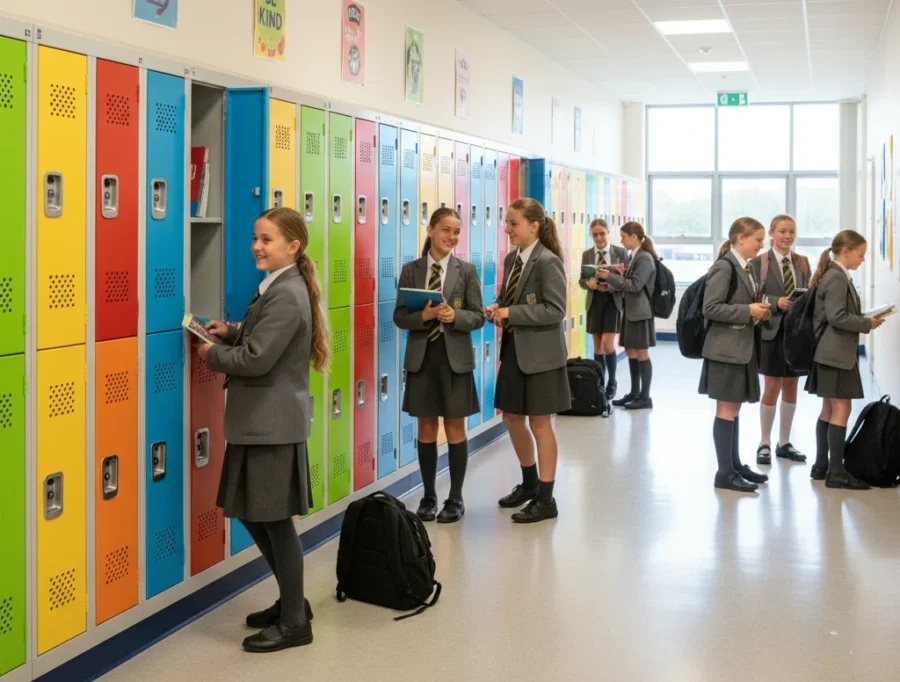
In recent years, educational institutions across the country have seen a modest but considerable spatial alteration. Corridors that were formerly desolate or only served as transitory thoroughfares are now being lined with rows of lockable storage units, reflecting a renewed institutional commitment to student welfare. The structural return of school lockers is a smart answer to a wide range of current educational difficulties, from physical health and safety considerations to the changing psychological demands of young students. As schools attempt to create settings that promote academic performance and personal growth, dedicated storage space has evolved from a convenience to a critical component of institutional architecture. By attentively examining the everyday realities of modern student life, it is clear that the strategic installation of school lockers serves as a basic pillar for a healthier, safer, and more structured educational environment.
One of the most important motivations underlying this infrastructure transition is a greater understanding of the physical demands imposed on growing children. On any given day, a student must haul an incredible amount of textbooks, exercise binders, specialised sporting kits, and technological gadgets from home to the classroom. Without the availability of school lockers, students are forced to carry this heavy weight on their backs during the school day, resulting in bad posture, muscle strain, and long-term spinal issues. Medical professionals have frequently cautioned that carrying large backpacks for extended periods of time might result in persistent back discomfort in teenagers, whose skeletal structures are still growing. By adding strong school lockers into their architectural designs, educational facilities provide an instant physical solution, allowing students to deposit heavy belongings and only carry what is strictly essential for their immediate lessons.
Furthermore, the changing nature of instructional resources has changed the contents of a student’s backpack, rather than making it lighter. While digital learning has brought tablets and computers into the classroom, these pricey gadgets have not completely replaced conventional textbooks, creating a hybrid baggage load in which students must carry both physical media and fragile electronic technology. In this context, school lockers serve as an important safety for expensive learning equipment, lowering the chance of inadvertent damage that happens when delicate computers are stuffed into overcrowded rucksacks with heavy water bottles and sports equipment. Modern school lockers provide protection, allowing parents and educators to rest confident that essential instructional instruments are safe from the chaos of packed classrooms and congested halls.
Aside from preserving physical equipment, the existence of school lockers contributes significantly to students’ feeling of personal responsibility and organisational autonomy. Learning how to manage one’s time and belongings is an important part of personal growth, and having a defined personal space within the larger institutional setting gives a practical framework for practicing these skills. When a student is allocated one of the school lockers, they are responsible for the preservation and administration of that area, which requires them to plan their day ahead, predict which items will be needed for certain morning or afternoon courses, and return to their base at regular intervals. This daily routine, made possible completely by the presence of school lockers, reflects the organisational demands of adult life and higher education, quietly training young people for future independence.
The psychological benefits of having a stable personal anchor inside a vast, often overwhelming educational institution should not be overlooked. Schools may be stressful places, with hundreds of youngsters navigating social relationships, academic requirements, and continual movement from room to room. In such a fast-paced environment, school lockers provide kids with a unique sense of security and stability, acting as a private sanctuary where they may store their personal belongings without fear of intrusion or loss. Knowing that their private notebooks, winter coats, and personal projects are safely stored permits students to devote their whole mental concentration to their academics. As a result, the existence of school lockers immediately leads to a calmer, more settled student population by significantly reducing the anxiety associated with losing or misplacing items.
In addition to individual psychological benefits, widespread use of school lockers has significant benefits for campus safety and cleanliness. When students are denied a central location to keep their things, they always bring them into the classrooms, resulting in a dangerous buildup of bags, jackets, and sports equipment under desks and along pathways. This congestion presents considerable trip risks for both instructors and students, as well as blocking critical exit routes during emergency drills or actual evacuations. By requiring the use of school lockers for heavy objects, administrators may maintain clear, unimpeded learning environments that adhere to rigorous health and safety rules. The visual difference is also noticeable, as halls and classrooms free of unnecessary clutter seem significantly more professional, spacious, and conducive to concentrated academic inquiry.
Another convincing reason for installing school lockers in modern academic institutions is to improve security and prevent theft. Unfortunately, schools are not immune to the loss or theft of personal property, and the financial ramifications for families may be significant when high-value things like as iPhones, musical instruments, or expensive apparel disappear. Without school lockers, students are compelled to leave their bags unattended during physical education courses, assemblies, or lunch breaks, presenting opportunities for theft or inadvertent mixing of similar things. Providing high-quality school lockers totally mitigates this risk, fostering a culture of security in which kids actively preserve their belongings, lowering the administrative load on staff who would otherwise spend valuable time investigating missing things.
The shifting climate and seasonal fluctuations emphasise the practical importance of school lockers in daily educational life. To protect themselves from adverse weather in the fall and winter, pupils commonly come to school wearing thick, wet jackets and carrying umbrellas. In the absence of school lockers, these wet objects are dragged inside classrooms and drape over the backs of chairs, producing a moist, unpleasant environment and potentially destroying homework laid out on desks. With access to school lockers, students may remove these outside layers as soon as they arrive, ensuring they enter the learning zone dry, comfortable, and ready to engage without the distraction of wet outerwear cluttering their immediate personal workplace.
Furthermore, the presence of school lockers helps to promote extracurricular activities like athletics, drama, and music. Students who engage in after-school football practices, cricket tournaments, or symphony rehearsals must carry specific equipment to school, which can be extremely difficult to transfer from class to lesson. Without school lockers, the sheer logistical challenge of handling this extra equipment might dissuade students from participating in valuable extracurricular activities. When a school provides roomy lockers that can hold violins, football boots, or art portfolios, it actively removes obstacles to participation, allowing kids to enjoy a well-rounded education with ease and enjoyment.
It is also important to evaluate the inclusive aspect of offering school lockers in an educational community. Every student comes from a different socioeconomic background, and noticeable differences in personal belongings might cause social tension or anxiety. By offering uniform, high-quality school lockers to all students, the school provides an egalitarian baseline in which everyone has equal access to storage facilities, regardless of family income. This sense of equality in shared settings promotes the institutional message that all students are regarded equally, while the private character of school lockers keeps individual distinctions in items hidden from public view.
Financial administrators in the educational sector are also seeing the long-term economic advantages of investing in sturdy school lockers. While the initial capital investment to acquire and install these units may be high, the eventual decrease in maintenance expenses for the entire school estate is significant. When large bags are repeatedly dragged along hallway walls and carelessly thrown onto classroom floors, they create significant wear and tear, resulting in scuffed painting, damaged plasterboard, and destroyed flooring. By centralising storage into sturdy school lockers, the physical effect on the building’s fabric is significantly minimised, preserving the facility’s visual appeal and allowing maintenance costs to be channelled towards key instructional resources rather than endless cosmetic repairs.
The developing design of school lockers has also made them significantly more appealing to current school planners, as modern units can be tailored to any architectural layout. Whether a school requires slimline units to preserve corridor width, heavy-duty external options for outdoor storage, or brightly coloured variations to complement a specific institutional branding, modern school lockers’ versatility ensures they can be seamlessly integrated into any setting. Because of this versatility, older, historic school buildings may be adapted with school lockers just as readily as newly erected academies, guaranteeing that all kids, regardless of building age, can benefit structurally and physically from safe storage.
Finally, the choice to give school lockers demonstrates a thorough knowledge of the holistic demands of the modern student. Education is no longer considered just as a process of academic teaching, but rather as a comprehensive responsibility of care that encompasses physical well-being, emotional stability, and the development of practical life skills. The modest locker, previously seen as an afterthought or vestige of old architectural styles, has emerged as an essential instrument in attaining these modern educational objectives. As more institutions recognise the long-term benefits of reducing physical strain, improving campus security, promoting student organization, and maintaining clear, safe classrooms, the trend toward installing high-quality school lockers is expected to spread across the educational landscape, ensuring that schools remain safe, nurturing, and highly efficient spaces for future generations.