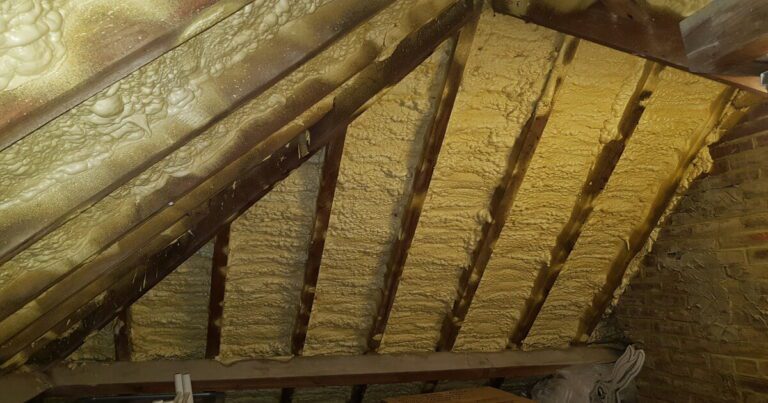







Spray foam insulation is an effective approach to decrease heat loss, increase acoustic comfort, and block draughts in a home. However, when it comes to removal, the type of foam utilised has a significant impact on the amount of effort required. Open cell and closed cell spray foam may appear identical from a distance, but when cured, they act significantly differently. This variation influences how quickly the material can be detached, how long spray foam insulation removal takes, how much mess is made, and if the underlying roof structure will need to be repaired.
Understanding whether your house has open cell or closed cell foam is thus one of the first tasks in planning spray foam insulation removal. It aids in determining the necessary tools, the amount of care required around timbers and membranes, the project’s expected duration, and the scope of any subsequent repair work. It can also affect how surveyors, lenders, and purchasers see the home, especially if the foam is put to the bottom of a sloped roof.
The distinction between open and closed-cell foam
Open cell spray foam is light, flexible, and sponge-like. Its structure includes linked air pockets, allowing it to expand significantly when applied. Once cured, it is quite soft and easily compacted by hand. Because of its low density, it is often used for thermal and acoustic insulation in loft spaces, walls, and other applications that need flexibility and sound reduction. Open cell foam also allows moisture vapour to move through more easily than closed cell foam, reducing the possibility of condensation being trapped in particular roof structures.
Closed-cell spray foam is denser, stiffer, and more rigid. Its cells are sealed, resulting in a tougher texture and greater resistance to moisture and air movement. It often provides more insulating performance per unit of thickness than open cell foam, and it can give stiffness to the surface on which it is put. This stiffness can be useful in certain situations, but it also means that the foam adheres securely to rafters, battens, felt, membranes, and other surfaces.
These physical variances explain why spray foam insulation removal is rarely a one-size-fits-all operation. Open cell foam may be easier to remove than closed cell foam, which frequently takes more power, more accurate tool use, and greater protection for the building fabric.
How does the foam type effect removal?
The main difficulty is adhesion. Because open cell foam is less thick and more flexible, it may readily detach from timbers and other surfaces. It may frequently be cut, peeled, or scraped away in portions, but total removal takes caution since shards may remain in gaps, joints, and uneven surfaces.
Closed cell foam is denser and more sticky. It provides a hard covering that may grasp roof timbers tightly, especially when sprayed thickly or used to consolidate an existing roof. Removing it without destroying the underlying structure necessitates time and precise mechanical labour. According to industry guidelines, closed cell foam is more difficult to remove due to its density, strong adhesive properties, and stiff structure.
This does not imply that open cell foam removal is always straightforward. Even if the foam has been spread widely, penetrated difficult-to-reach gaps, or put over wires, pipelines, or delicate membranes, the process can be lengthy and labour-intensive. However, as a general rule, closed cell spray foam insulation removal is more difficult, slower, and more likely to reveal problems that require treatment.
The significance of an early survey
Before any spray foam insulation removal begins, the property should be thoroughly inspected. A survey should determine whether the foam is open or closed cell, how thick it is, where it was put, and whether it covers the entire roof area or only a portion of it. The condition of the timbers, roof covering, ventilation pathways, and any services in the loft should also be examined.
This examination is important because the foam may hide issues beneath it. Moisture damage, timber degradation, insufficient ventilation, poor installation, and roof covering flaws can all be hidden from view. A thorough assessment identifies these concerns before removal begins, allowing the job to be planned safely and realistically.
Spray foam insulation is considered a major change to a property, and its existence may influence a surveyor’s expert evaluation of value. Mortgage lenders may also request that a surveyor evaluate the insulation before making a loan decision. For this reason, homeowners considering spray foam insulation removal should preserve detailed records of the initial evaluation, foam pictures, and any expert reports generated during the procedure.
Remove open cell spray foam.
Open cell spray foam is often the simplest of the two to remove. Its softer, more flexible nature allows it to be easily sliced into manageable portions and dragged away from the surface. Depending on the thickness and coverage, removal may need hand tools, scrapers, cutting equipment, or cautious manual extraction.
The primary problem with open cell foam is attaining a complete finish. Because the substance is light and porous, tiny particles and thin residues can adhere to rafters, nails, joints, and uneven timber surfaces. These remains must be carefully removed in order to thoroughly assess the roof structure and install any replacement insulation.
Open cell foam can also be found in huge quantities since a thicker layer is frequently required to obtain equal thermal performance to closed cell foam. This can increase the amount of material that has to be removed, even if each piece is relatively easy to remove.
The work space should be enclosed and ventilated during spray foam insulation removal. Dust, foam particles, and debris can drift throughout a home if the loft or work area is not adequately prepped. A professional removal technique includes protective protection, dust control, and cautious garbage disposal.
Removing closed-cell spray foam
Closed cell spray foam insulation removal is typically more complicated. Because of its stiff structure, the foam cannot be easily peeled away in soft chunks. It frequently has to be chopped, chiselled, scraped, or mechanically removed from the timbers. The individual doing the task must strike a balance between thoroughly removing the foam and avoiding damage to rafters, roof felt, membranes, wiring, and other components.
Closed cell foam is more difficult to remove than open cell foam because it adheres so tightly to surfaces. According to expert advice, closed cell removal might take substantially longer than open cell removal because the thick foam sticks more strongly to the timber. The precise duration depends on the thickness of the application, the size of the roof space, accessibility, and the state of the underlying structure.
When closed cell foam is removed, the likelihood of discovering damage increases. Because the material is hard and moisture-resistant, it can occasionally obscure flaws with the roof structure or obstruct adequate timber examination. If the foam was applied to an older or badly maintained roof, removal may uncover decay, movement, insufficient ventilation, or problems that must be repaired before the roof can be reinsulated.
This is why closed cell spray foam insulation removal should be treated as a structural and remedial job rather than simply removing insulation. The goal is not simply to remove the foam, but also to keep the roof area safe, dry, aired, and ready for future usage.
Damage hazards during removal
The most serious risk of spray foam insulation removal is damage to the underlying roof structure. Rafters, joists, battens, felt, and membranes can all be damaged if foam is removed too vigorously. This is especially true for closed cell foam, where high adhesion might lead to the temptation to use powerful instruments or scrape excessively.
Open-cell foam poses a distinct type of risk. Because it is softer, it may be removed rapidly; nevertheless, negligent labour might rip roof membranes, dislodge fixings, or leave residue in tight areas. In both circumstances, the goal is controlled removal rather than speed.
Electrical wires, plumbing, ventilation ducts, and structural timbers may be embedded in or near the foam. Before work begins, they should be recognised and safeguarded. A meticulous removal strategy should include safe access, dust and debris containment, living area protection, and a mechanism for safely disposing of the material.
What happens once the foam is removed?
Once the foam has been removed, the exposed roof structure should be thoroughly examined. This is the stage at which concealed issues frequently become apparent. Timber may require cleaning, drying, treatment, or replacement. Ventilation pathways may need to be repaired. Roof coverings, membranes, and fasteners may require replacement if they were damaged by the foam or the removal procedure.
A thorough examination following spray foam insulation removal is especially crucial if the home is being sold or refinanced. Lenders and surveyors frequently need confirmation that the roof structure is sound and that the loft space can be thoroughly investigated. Clear images, reports, and records of any corrective work might be useful in this process.
Once the roof has been repaired, the home will likely require a replacement insulation plan. Depending on the roof design, ventilation needs, and intended use of the loft, this might include mineral wool, rigid insulation boards, or another appropriate material. The replacement insulation should be suitable with the property’s structure and should not cause the same issues that led to the foam being removed.
Cost, Time, and Practical Expectations
The type of foam influences not only the physical process, but also the estimated cost and timeline. Open cell spray foam insulation removal is frequently faster since it is easier to separate and handle. Closed cell removal typically necessitates additional personnel, specialised tools, and careful work around the roof structure, which can increase both time and expense.
The total magnitude of the project is also important. A little amount of foam sprayed to accessible rafters is far easier to remove than foam covering an entire pitched roof, especially if access is limited or the roof space includes services. The state of the roof, the necessity for repairs, and the need for new insulation can all contribute to the total scope.
Homeowners should avoid seeing spray foam insulation removal as a simple cleaning task. It is a construction activity that may disclose structural flaws, necessitate garbage removal, and require additional work to restore the roof space.
Choosing the Right Approach
The first objective is to determine the type of foam and acquire an impartial assessment of the roof’s condition. This gives a clear starting point for planning spray foam insulation removal and helps to minimise unanticipated issues once the job begins.
If the foam is open cell, the procedure may be very simple, although diligence is still required. If it is a closed cell, the job will most likely take longer, involve more careful mechanical removal, and place a larger emphasis on roof structural protection. In any scenario, the job should be done with adequate containment, safety precautions, and a strategy for assessing and fixing the roof later.
Finally, the distinction between open and closed cell spray foam is not only a technical one. It influences the whole removal process, from the equipment and procedures utilised to the state of the timbers exposed underneath. Understanding these distinctions before beginning spray foam insulation removal allows homeowners to approach the process with realistic expectations and make smarter decisions about their property’s future.
Get in Touch:
Countrywide Roofing & Insulation
1st Floor, Colonnade House, 2 Westover Rd, Bournemouth BH1 2BY, United Kingdom
01202 942777
countrywideinsulation.co.uk